


Updated September 22, 2026.
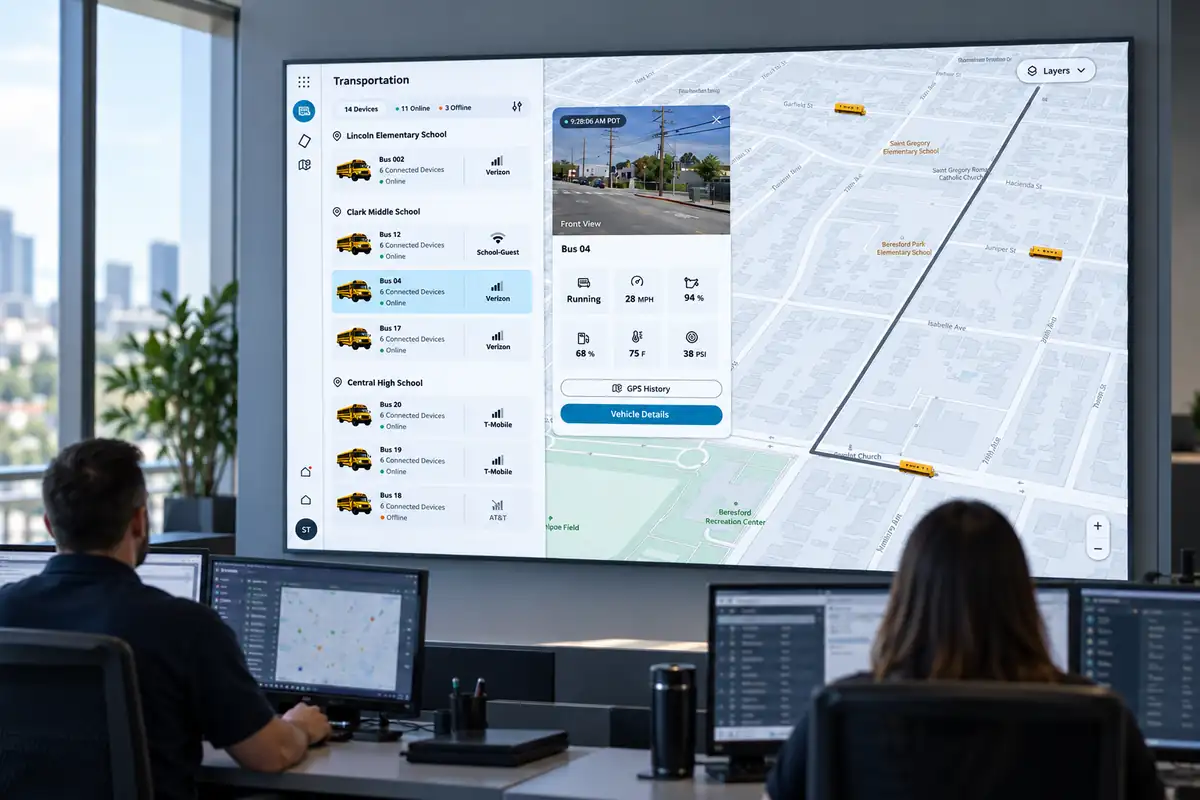
The main Samsara alternatives fall into two groups. Telematics-first platforms such as Motive, Geotab, Verizon Connect, Lytx and Netradyne compete with Samsara on tracking, driver safety video and compliance. Security-platform-first options such as Verkada Transportation start from the other direction: vehicle cameras managed in the same console as a company's building cameras.
Which group fits depends on what your fleet program is really for. If hours-of-service logging, routing and fuel data drive the purchase, you are choosing among telematics platforms. If the job is evidence, passenger safety and security investigations across vehicles and facilities, a security-first platform deserves a look.
This guide compares the approaches using only what each vendor publishes about itself. Monarch Connected is an authorized Verkada reseller, so we say plainly where Verkada fits and where it doesn't.
What Samsara Offers, and Why Fleets Look Around
Samsara positions itself as a broad connected-operations platform. On its own site, it describes fleet telematics as "real-time GPS, routing, fuel, compliance," offers AI dash cams and in-cab alerts, equipment and trailer monitoring, and ELD compliance it calls "FMCSA-registered and third-party certified." It also promotes an app marketplace of third-party integrations for systems such as TMS, fuel cards and maintenance software (source: samsara.com telematics product page, September 2026).
Samsara also sells beyond vehicles. Its Site Visibility product is pitched to "consolidate data from fleet and facilities onto one platform," with the ability to "make any IP camera smart" by adding cloud connectivity and AI to existing camera infrastructure.
So why do fleets search for Samsara alternatives? Common reasons are practical rather than dramatic:
- Contract renewal is approaching and procurement wants competitive bids.
- Scope mismatch: a fleet uses one or two modules and wants a tool built around that need.
- A different buyer: security or facilities teams now own vehicle video and want it next to building cameras.
- Driver relations: a fleet wants a different coaching or recognition model.
- Integration fit with existing dispatch, maintenance or security systems.
None of these mean Samsara is the wrong product. They mean the evaluation should start from requirements, not from a vendor list.
Samsara Competitors: The Telematics-First Platforms
These are the Samsara competitors fleets commonly compare on tracking, dash cams, compliance and video-based driver safety. Each description below comes from the vendor's own website as of September 2026.
Motive
Motive describes an "all-in-one" platform covering AI dashcams with "360° visibility," an electronic logging device, fleet management with "deep insights into vehicle health, location, and use," equipment monitoring, and the Motive Card, which it calls an "AI-powered fleet card" (source: gomotive.com). The fuel and spend card is a distinctive piece for fleets that want payments and telematics in one place.
Geotab
Geotab's core hardware is the Geotab GO, which it describes as "a compact vehicle tracking device that plugs easily into a vehicle's OBD II port." Its ELD workflow "automates data collection and provides step-by-step workflows," the GO Focus Plus is its AI dash cam, and it emphasizes an open platform and marketplace where developers can integrate MyGeotab data with external systems. Geotab also highlights EV management, including battery state of health (source: geotab.com).
Lytx
Lytx is centered on video safety. It describes DriveCam devices as "engineered to detect and categorize driving risk," with "AI-powered alerts and coaching workflows" aimed at distracted, drowsy and risky driving. It also offers "driver compliance tools for training, management and regulatory readiness" (source: lytx.com). That makes it relevant for fleets whose top priority is a coaching program.
Verizon Connect
Verizon Connect offers GPS fleet tracking through its Reveal platform, AI dashcams it says provide "near 360-degree evidence that protects against false claims," ELD tools to "automate hours of service tracking," electronic DVIRs, and dispatch features for field service teams (source: verizonconnect.com). The dispatch features are aimed at service fleets that send technicians to jobs.
Netradyne
Netradyne's Driver•i camera platform emphasizes "recognition-based safety," including its GreenZone score and DriverStars awards for positive driving. On its compliance page, Netradyne says its camera functions as "both an AI-powered safety camera and an FMCSA-registered ELD," covering hours of service, DVIR and IFTA mileage reporting from one device.
A Different Approach: Security-Platform-First
Every platform above starts with the vehicle as a telematics asset and adds video. A security-platform-first approach starts with video security across the whole organization and extends it into vehicles.
Verkada Transportation, announced in September 2026, is the clearest example. According to Verkada's transportation page and launch materials, it includes:
- Three ruggedized camera models — a fisheye, a low-profile dome and an exterior wedge — that Verkada says can secure areas "inside or outside a vehicle."
- A 5G and Wi-Fi vehicle gateway (with LTE listed on the gateway page) that powers up to 10 cameras, captures GPS location and trip history, and reads vehicle diagnostics.
- Driving events such as speeding and harsh braking, which Verkada says you can review "with paired footage and location for context."
- Diagnostics such as fuel and oil levels.
- Privacy controls, including face blurring and facial recognition disabled by default.
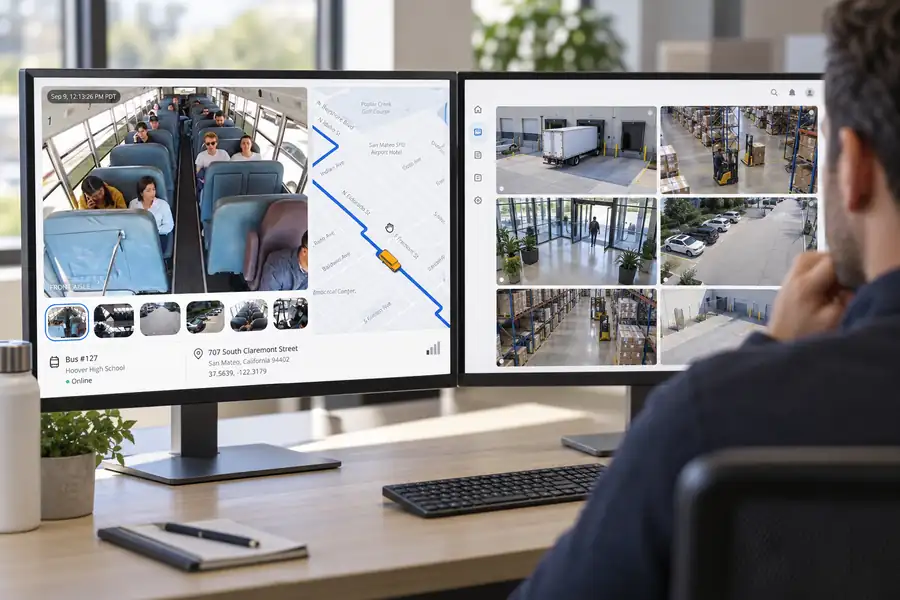
- Command, the same cloud platform Verkada uses for its building cameras, where teams can "run investigations and manage fleet security in a single cloud-based dashboard."
The distinctive capability is search across vehicles and places. Verkada describes GPS video search — click a location on a trip to pull related footage — and says that when the vehicle is unknown you can "pull up footage of all vehicles that passed by an address," plus people and vehicle search by attributes like clothing color.
Verkada calls this "one cloud-managed system." For a transit agency, school district, campus or company that already runs Verkada cameras in its buildings, the appeal is working in one platform across fixed sites and moving vehicles instead of two. You can read how we approach this on our transportation security solutions page.
Comparison: What Each Approach Is Strongest At
This table compares categories, not products. Confirm specifics with each vendor for your fleet.
| Criterion | Telematics-first (Samsara, Motive, Geotab, Verizon Connect) | Video-safety specialists (Lytx, Netradyne) | Security-first (Verkada Transportation) |
|---|---|---|---|
| ELD / hours of service | Core offering, per each vendor's site | Netradyne offers an FMCSA-registered ELD; Lytx describes compliance tools | Not part of what Verkada announced |
| Driver coaching workflows | Built in | Core focus | Driving events with paired footage for coaching |
| Routing, dispatch, fuel | Core offering | Not their core focus; check integrations | Not part of the announcement |
| Vehicle video evidence | AI dash cams | Core focus | Interior and exterior cameras with GPS search |
| Building and site cameras in same console | Samsara Site Visibility; varies by vendor | Not described on their homepages | Core design — same Command platform as building cameras |
| Passenger-area coverage (buses, shuttles) | Varies | Varies | Fisheye and dome cameras, face blurring, person-of-interest alerts |
| Third-party integration ecosystem | Large marketplaces (Samsara, Geotab) | Integrations available | Verkada platform integrations; fleet-specific ones not detailed |
When Samsara Is the Right Choice
Being fair about this saves everyone time. Samsara is likely the stronger fit when:
- You need ELD and hours-of-service compliance from the same system that runs your cameras. Samsara describes its ELD as FMCSA-registered.
- Operations data drives ROI: routing, fuel, idling, maintenance and equipment utilization matter as much as video.
- You rely on integrations with a TMS, fuel card or maintenance system that Samsara's marketplace already supports.
- Your fleet includes trailers, reefers and heavy equipment you want tracked alongside trucks.
- You already run it well. A working deployment with trained drivers and admins has real value; switching has costs.
If most of those are true, the practical move may be renegotiating your Samsara contract rather than replacing it. Our guide to the best commercial truck camera systems covers the dash-cam side in more depth.
When a Security-Platform-First Approach Makes Sense
A platform like Verkada Transportation tends to fit when:
- The security team owns the problem. The questions are "what happened on bus 14 at 3:40 p.m.?" and "did this person board any of our vehicles?" rather than "how many hours can this driver work?"
- You carry passengers. Transit, school transportation, campus shuttles, paratransit and employee shuttles need interior coverage and privacy controls.
- You already run Verkada in your buildings and want one set of users, roles and investigation tools.
- Vehicles aren't subject to the ELD rule, or ELD is already handled by a separate system you intend to keep.
- Investigations span places and vehicles — for example, following an incident from a depot into a vehicle and back.
ELD and Hours of Service: The Question That Decides a Lot
For interstate commercial carriers subject to the ELD rule, this is often the deciding factor. The Federal Motor Carrier Safety Administration keeps an official list of registered, self-certified ELDs and periodically removes devices that fail to meet requirements; carriers using a removed device must replace it within a deadline FMCSA sets.
Here is how the vendors in this guide describe ELD on their own sites:
- Samsara, Motive, Geotab and Verizon Connect each describe ELD or hours-of-service tools as part of their platforms.
- Netradyne says its Driver•i camera is also an FMCSA-registered ELD.
- Lytx describes driver compliance tools; confirm ELD specifics with Lytx directly.
- Verkada Transportation: ELD and hours-of-service logging are not part of what Verkada announced. Verkada's pages describe cameras, a gateway, GPS, driving events and diagnostics, not a logging device.
That makes Verkada a poor sole replacement for a carrier that depends on its telematics provider for ELD. It can still make sense next to an ELD, for fleets where passenger and security video matter more than logs, or for fleets not subject to the rule. Always check the FMCSA list for any device you plan to use for compliance.
Migration Considerations Before You Switch
Switching fleet platforms is an operations project, not a software download. Plan for these:
Contracts and term dates
Read your current agreement for term length, auto-renewal windows, notice periods and early-termination terms. Fleet contracts can run for multiple years and may renew automatically if notice isn't given. Put the notice deadline on a calendar before you start talking to vendors.
Hardware swap and installation
New cameras and gateways mean vehicle downtime. Plan installs around maintenance cycles, confirm mounting positions meet federal and state windshield rules (see our guide to dash cam laws by state), and decide what happens to removed hardware you may own or lease.
ELD continuity
Never leave a regulated vehicle without a compliant ELD. Run old and new in parallel until drivers are trained and logs are verified, and export historical records you are required to keep.
Historical footage and data
Export any footage tied to open claims, lawsuits or investigations before the old contract ends — deleting evidence you are obligated to keep can create legal problems. Our guide to driver exoneration covers preservation.
Driver communication and policy
A new camera system is a change drivers notice immediately. Update your written policy, deliver notice and acknowledgments, and, for unionized fleets, check bargaining obligations before installation.
Integrations
List every system that consumes data from your current platform — payroll, dispatch, maintenance, fuel, insurance reporting — and confirm how each will be fed after the switch.
Can You Run Two Systems Side by Side?
Yes. One pattern is a telematics platform for ELD, routing and fuel, alongside a security camera platform for passenger-area video and investigations. The trade-off is two consoles, two contracts and two hardware footprints in the vehicle. Whether that's worth it depends on who uses the footage and how often. For smaller vans and service vehicles, compare approaches in our fleet vehicle dash cam guide.
Evaluation Checklist for Samsara Alternatives
- Write down the top three problems the platform must solve (compliance, safety coaching, security evidence, operations).
- Identify which vehicles are subject to the ELD rule, and check any candidate device against FMCSA's registered list.
- Decide who owns the system day to day: safety, operations, IT or security.
- List existing integrations that must keep working.
- Confirm the current contract's renewal and notice dates.
- Ask each vendor for a pilot on your own vehicles, routes and lighting conditions.
- Review sample footage from a real incident type you care about (backing, sideswipe, passenger disturbance).
- Check privacy controls: face blurring, role-based access, audit logs, footage sharing controls.
- Confirm retention, export and data-ownership terms in writing.
- Plan install downtime, driver training and a parallel-run period.
- Get written pricing for hardware, licenses and installation — no vendor comparison is complete without it.
Frequently Asked Questions
What are the main Samsara alternatives?
The most common Samsara alternatives are Motive, Geotab, Verizon Connect, Lytx and Netradyne on the telematics and video-safety side, and security-first platforms such as Verkada Transportation for fleets that want vehicle video managed alongside building cameras.
Who are Samsara's biggest competitors?
Among telematics platforms, Motive, Geotab and Verizon Connect overlap most with Samsara's tracking, dash cam and ELD offerings. Lytx and Netradyne compete most directly on video-based driver safety. Which is "biggest" depends on the fleet segment.
Does Verkada Transportation replace an ELD?
No. ELD and hours-of-service logging are not part of what Verkada announced. Fleets subject to the ELD rule would keep a registered ELD alongside Verkada cameras.
Is Verkada Transportation available now?
Verkada announced the Transportation line in September 2026. Monarch Connected is an authorized Verkada reseller; contact us for availability, or see our transportation solutions overview for how it fits your vehicles.
How long does it take to switch fleet platforms?
It depends on fleet size, install logistics, contract terms and whether ELD is involved. Plan for vendor evaluation, a pilot, staged installs and a parallel-run period rather than a single cutover date.
Can I keep Samsara and add Verkada cameras?
Yes. Some fleets keep a telematics platform for ELD, routing and fuel, and add security cameras for passenger areas and investigations. The cost is running two systems, so weigh it against how often security teams actually need vehicle footage. Our team at Monarch can help you map which vehicles need which system.