


Updated September 16, 2026.
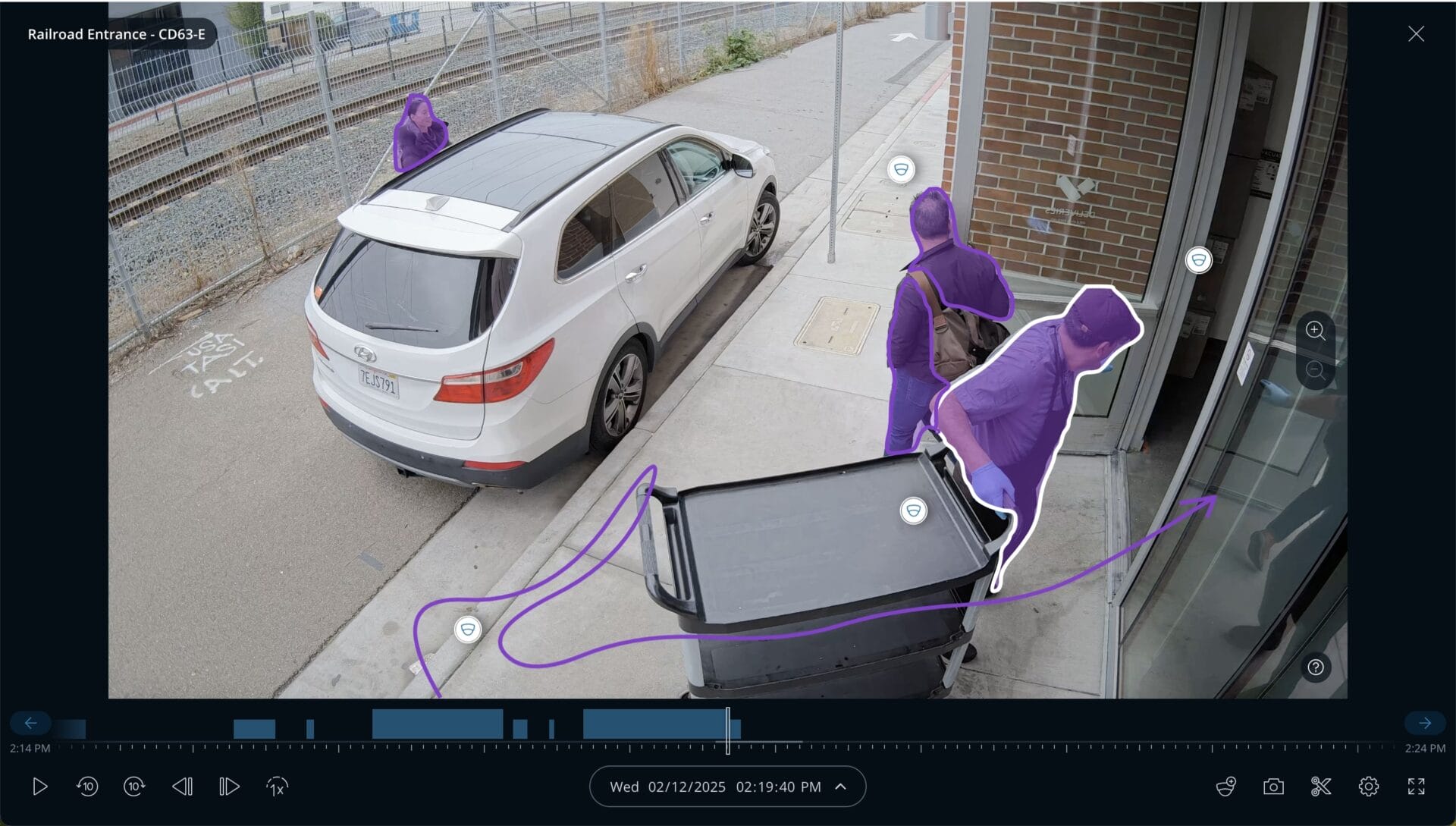
AI video analytics interprets video to identify selected objects, events or patterns. It may help a reviewer find a vehicle, count entries or receive an alert when a person enters a defined area. Its usefulness depends on the specific feature, camera view and response workflow, not simply whether the product is described as AI.
Begin with one question the system should help answer. “Show vehicles entering the service lane after closing” is testable. “Make the site smarter” does not identify what to install or how to accept it.
Separate detection, search and action
Detection classifies an event or object in a scene. Search lets a reviewer find records using the information the system retained. An alert sends information to a person or another system. These functions may have different processing, storage, licensing and connectivity requirements.
Avigilon's video analytics guide describes analytics categories within the surveillance market. For a specific feature example, Verkada's LPR setup documentation describes its plate-recognition configuration. Neither source establishes that every camera supports the same functions or that a feature will meet your site's acceptance criteria.
Ask the supplier to identify the exact supported hardware, software version and license. Then trace a sample event from the camera image to the record and the person expected to act.
Compare features by their purpose
| Feature | Useful question | Important acceptance test |
|---|---|---|
| Person or vehicle classification | What entered the defined area? | Include intended targets and ordinary nuisance motion |
| Line crossing or zone detection | Did an object cross this boundary? | Test direction, occlusion and normal authorized movement |
| Dwell-time alert | Did an object remain longer than the configured threshold? | Include legitimate waiting and objects briefly hidden from view |
| People counting | How many crossings were recorded? | Compare with a permitted manual count under representative traffic |
| Plate recognition | Which plate was captured at this lane? | Review original images, correct reads, wrong reads and missing results |
| Object-change detection | Did an expected object appear or disappear? | Test lighting changes, obstruction and the defined scene |
These are evaluation categories, not a promise that every product offers each one. Face matching and other sensitive uses require a separate purpose, permission and policy review before deployment.
Check the camera view first
A software feature cannot establish that the camera captures the required detail. Ask the vendor to document its requirements for the selected analytic and demonstrate the proposed location. Review distance, mounting angle, lighting, motion and obstructions.
Use recordings from relevant day and night conditions. Include normal activity that could resemble the event of interest. A parked delivery vehicle, a queue or changing shadows may expose a problem that a staged daytime demonstration misses.
For plate-specific placement and testing, see our license plate recognition guide. For general camera selection, see what AI security cameras do.
Measure errors in both directions
Count events that should have been detected and whether the system detected them. Separately count alerts that did not require the intended action. Keep the underlying image or clip so a reviewer can understand each result.
Agree on definitions before the pilot. For example, distinguish a detected person from an actionable intrusion: an authorized cleaner can be correctly classified as a person while producing an unwanted after-hours notification. The remedy may be a schedule or workflow change rather than a different classifier.
Do not report a single accuracy percentage without its denominator, conditions and error categories. Record changes to camera settings, software and zones so results from different configurations are not silently combined.
Give every alert an owner
Specify who receives an alert, when they are expected to review it and what they do if it is uncertain. Include a fallback for an unavailable contact. Confirm that the reviewer can access the relevant evidence without receiving broader permissions than their job needs.
Test the full path during an agreed session. An event appearing in an administrator's dashboard does not prove that the normal on-call user receives it. Coordinate tests with any monitoring provider to avoid an unintended dispatch.
Review processing and information handling
Ask where each function runs and where video and metadata are stored. Demonstrate which functions continue during an internet outage and how records are recovered afterward. A detector running on the camera does not by itself guarantee remote notification without connectivity.
Document the business purpose, authorized searches, retention and export process. Review applicable privacy requirements with the responsible adviser, especially before enabling identity-related functions. Treat analytics results as information to investigate rather than a conclusive finding about a person's conduct.
Start with a bounded pilot
Select representative views and write the acceptance tasks before configuring the system. Keep existing response arrangements in place while evaluating a new feature. Include staff time for reviewing results, adjusting settings and maintaining the installation in the cost comparison.
The AI security pilot guide provides a sample planning sequence. Contact Monarch with the specific event, location and response requirement to define a focused evaluation.
Frequently asked questions
Can analytics run on existing cameras?
Sometimes, through supported camera, server or hosted software. Verify exact model, stream, resolution, firmware and licensing compatibility. Demonstrate the required function before assuming an existing feed is sufficient.
Does AI eliminate false alarms?
No. Measure unwanted alerts and missed events at the site. Configuration and operating procedures can matter as much as the advertised feature name.
Will analytics replace a person watching cameras?
It can change the review workflow, but the required human response remains a separate decision. Measure workload and coverage during a pilot before changing staffing or response responsibilities.
How long should a pilot run?
Long enough to exercise the relevant operating patterns and agreed tests. A quiet period with no alerts does not establish performance on rare events; use coordinated, permitted test scenarios and document the limits of the evaluation.